4-Leg Standing Desk vs 2-Leg: Stability, Cost, and When It's Worth It
Created on 03.16
We all want a workspace that keeps us healthy and productive. Finding the right adjustable setup can feel overwhelming with so many options available today. We are here to guide you through these choices to find the best fit for your home office.
Most people start with a standard dual-pillar model, but is that enough for your heavy gear? We will explore if a sit-stand workstation with extra support fits your lifestyle better. It is vital to match your furniture to your specific workload.
4 leg standing desk
Stability often becomes a concern when you raise your equipment to full height. Many users find that a sit-stand desk offers enough balance for daily tasks, but others need more. This extra foundation prevents annoying wobbles during important meetings or deep work sessions.
Our team understands that your budget matters just as much as performance. We aim to break down the costs and benefits to help you choose wisely. Let us find the perfect balance for your professional environment together.
Key Takeaways
- Four-pillar bases provide maximum stability at full height.
- Dual-motor systems are more affordable for light office work.
- Weight capacity increases significantly with four columns of support.
- Side-to-side wobble is nearly eliminated in premium designs.
- Choosing the right frame ensures a long-lasting ergonomic investment.
Understanding Standing Desk Frame Designs
It's important to know how standing desk frames work. This knowledge helps you choose between a 2-leg and a 4-leg desk. The design of the frame affects the desk's stability, function, and how it feels to use.
The frame is key for adjustable height desks. A good frame makes height changes smooth and keeps the desk stable. This is important for a comfortable work area.
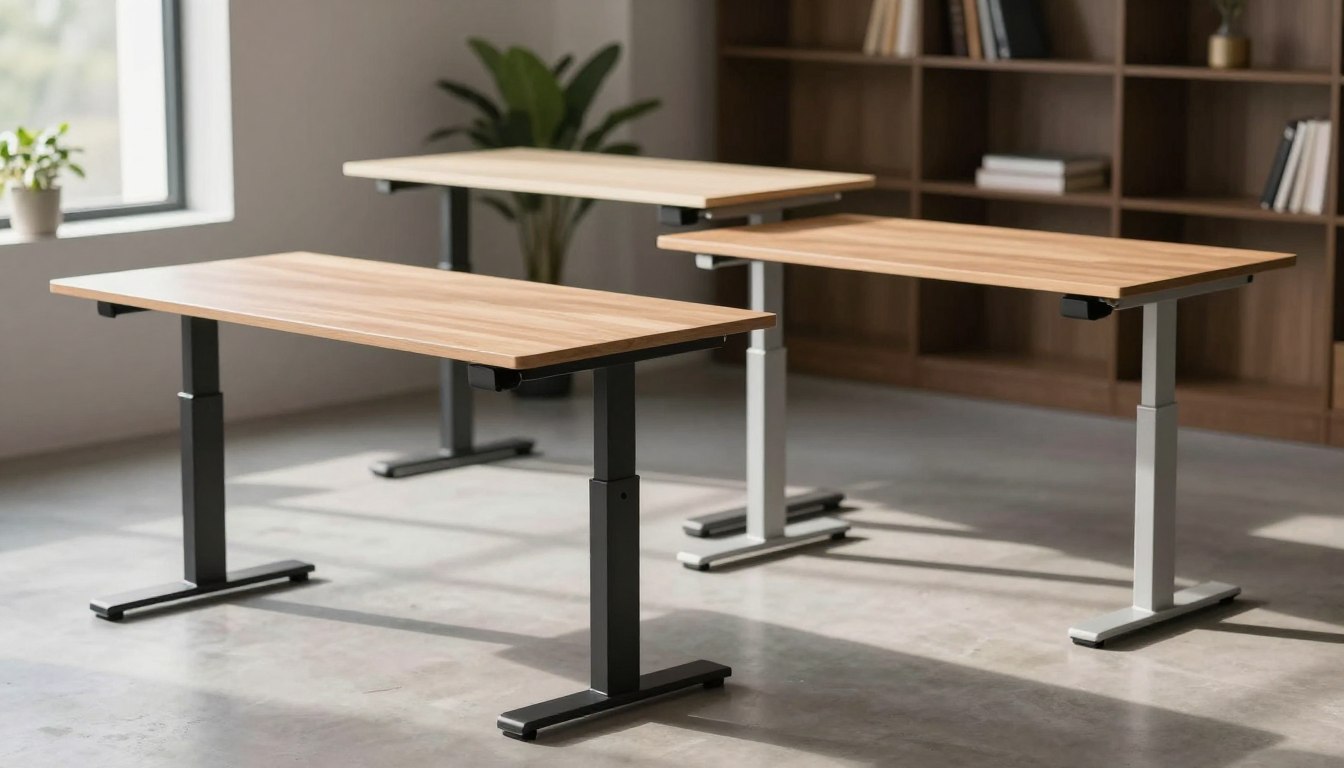
A modern workspace featuring various standing desk frame designs, prominently showcasing both 2-leg and 4-leg configurations. In the foreground, a sleek 4-leg desk with intricate metalwork stands resiliently, while in the middle ground, a minimalist 2-leg frame displays a unique, ergonomic shape. The background features subtle silhouettes of office elements like bookshelves and plants, enhancing the office ambiance. The scene is well-lit with soft, natural light filtering through a nearby window, casting gentle shadows. Capture the image from a dynamic angle, focusing on the structural details and craftsmanship of the desks, creating a professional yet inviting atmosphere that emphasizes stability and innovation in standing desk design. No text or watermarks present.
How 2-Leg Standing Desks Work
Two-leg desks use a cantilever design. They have two legs that support the desk, usually in the middle or back. This design is great for those who like a clean desk.
The cantilever makes height changes easy. But, these desks might not be stable if they're too heavy or not set up right.
How 4-Leg Standing Desks Work
Four-leg desks focus on stability. They have four legs, one at each corner, for a strong base. This makes them good for heavier loads.
These desks are stable and less likely to wobble. They also offer more customization options. This meets different user needs and preferences.
Key Structural Differences Between Frame Types
The main difference is in design and stability. Two-leg desks are sleek but might not handle heavy loads well. Four-leg desks are more stable and durable.
- 2-leg desks: Sleek design, potentially less stable under heavy loads.
- 4-leg desks: Enhanced stability, suitable for heavier loads and larger work surfaces.
Knowing these differences helps you pick the right desk. It ensures a comfortable and productive work space.
Stability Comparison: Which Adjustable Height Desk Frame Holds Up Better
We're looking at how 2-leg and 4-leg desks stack up in terms of stability. This is key for those who work long hours at their desks. It affects their productivity and comfort.
Wobble and Lateral Movement Testing
We'll check how 2-leg and 4-leg standing desks handle wobble and side-to-side movement.
Side-to-Side Stability
Side-to-side stability tests show that 4-leg desks resist lateral forces better. This is great for those who lean on their desks or have heavy monitors.
A detailed side-by-side comparison of two types of adjustable height desks in a modern office setting. In the foreground, a 4-leg standing desk on the left, showcasing its sturdy frame and stability features, contrasted with a 2-leg standing desk on the right, highlighting its sleek design. Both desks are slightly raised, displaying a level of height adjustment. In the middle ground, a professional male and female, dressed in smart business attire, are testing the desks' stability by leaning gently on them. The background features a softly lit contemporary office space with plants and a large window, creating a bright and inviting atmosphere. The image should be captured with a 35mm lens, focusing sharply on the desks while gently blurring the background to emphasize the comparison.
Front-to-back movement tests show that 2-leg desks might wobble more due to their narrower profile. But, high-quality 2-leg desks with strong materials can help.
Weight Capacity and Load Distribution
It's important to know how weight capacity and load distribution impact stability.
Maximum Load Ratings
Generally, 4-leg desks can handle more weight because they spread the weight evenly across four points.
How Weight Affects Stability on Each Design
The weight on a standing desk greatly affects its stability. Too much weight can make 2-leg desks wobble more. But, 4-leg desks stay steadier under heavy loads.
Performance at Different Heights
How standing desks perform at different heights is also crucial for stability.
Stability at Sitting Height
At sitting height, both 2-leg and 4-leg desks are stable. But, 4-leg desks are slightly more stable.
Stability at Maximum Standing Height
At their highest standing height, the stability difference is clear. 4-leg desks stay steadier.
Real-World Usage Scenarios
In everyday use, desks face various tests. This includes typing, mouse use, and placing heavy objects.
Cost Analysis: Breaking Down the Price Difference
The cost of 2-leg and 4-leg standing desks can vary a lot. It's important to know what you're getting for your money. We'll look at what makes them different and help you choose the right work from home essentials.
Entry-Level 2-Leg Sit-Stand Desk Pricing
Entry-level 2-leg sit-stand desks start at about $150. They're great for those watching their budget or with small spaces. But, they might not have as many features or last as long as 4-leg desks.
Mid-Range and Premium 4-Leg Desk Pricing
Mid-range 4-leg desks start at around $300. They offer more features, better quality, and can hold more weight. Premium models can cost over $800, with advanced features and durable materials. For example, a top 4-leg desk might have a standing desk converter for more flexibility.
What You Get for the Extra Cost
4-leg desks cost more for good reasons. Let's look at some key differences.
Build Quality Differences
4-leg desks are pricier because they're built better. They use stronger materials and are more stable and durable.
Warranty and Support Variations
Premium 4-leg desks come with longer warranties and better support. This gives you peace of mind and protects your investment.
Feature | 2-Leg Desk | 4-Leg Desk |
Price Range | $150-$400 | $300-$800+ |
Build Quality | Basic | Robust |
Warranty | 2-3 years | 5-10 years |
Long-Term Value and Return on Investment
When buying a standing desk, think about its long-term value and potential return on investment.
Durability Over Time
A more expensive 4-leg desk may last longer and need less upkeep than a cheaper 2-leg desk. This can save you money over time.
Resale Value Considerations
Premium desks hold their value better. If you sell your desk later, a high-quality 4-leg desk will likely sell for more than a basic 2-leg desk.
In conclusion, while 2-leg desks might be cheaper at first, a 4-leg desk's better quality, warranty, and value make it a worthwhile investment. When setting up your home office with work from home essentials, consider these points to make a smart choice.
When a 4-Leg Standing Desk Is Worth the Investment
Choosing between a 4-leg and a 2-leg standing desk depends on your workspace and needs. A 4-leg standing desk is great for stability and can handle heavier loads. This makes it perfect for certain work environments.
Ideal Scenarios for Choosing a 4-Leg Ergonomic Work Station
A 4-leg ergonomic work station is best when your desk will be used a lot or hold a lot of equipment.
Heavy Equipment and Multiple Monitor Setups
For desks with multiple monitors or heavy equipment, a 4-leg desk is better. It's more stable and can hold more weight. This keeps your desk steady, even with a lot on it.
Taller Users and Maximum Height Requirements
Taller people need desks that can go higher. A 4-leg desk is strong enough to support taller users without losing stability.
Commercial and Shared Office Environments
In shared offices, a 4-leg desk is better. It's durable and can handle frequent changes and heavy use.
When a 2-Leg Desk Makes More Sense
Even though 4-leg desks have many benefits, there are times when a 2-leg desk is better.
Home Office and Work From Home Essentials
For small home offices or work-from-home setups, a 2-leg desk is a good choice. It's cheaper and takes up less space.
Limited Budgets and Space Constraints
If you're on a tight budget or have little space, a 2-leg desk is a smart pick. It offers the basics of a standing desk without the high cost of 4-leg models.
Minimal Desktop Equipment
For those with little on their desk, a 2-leg desk is enough. It's adjustable and functional without the extra cost of a 4-leg desk.
Your Modern Office Setup Needs Assessment
It's important to know what you need before choosing a desk. Think about the weight of your stuff, how much space you have, and your budget. This will help you pick the right desk for your modern office setup.
Conclusion
Choosing the right sit-stand desk is key for a healthier work space. We've compared 4-leg and 2-leg standing desks. They differ in stability, cost, and what they're best for.
Think about what you need when choosing between a 2-leg and a 4-leg desk. If you want something stable and premium, go for a 4-leg desk. But, if you're watching your budget or have small space, a 2-leg desk is a smart choice.
The perfect ergonomic work station meets your needs for stability, budget, and space. Knowing the pros and cons of each desk type helps you choose wisely. This choice can boost your productivity and health.
FAQ
Why should we consider a 4-leg standing desk over a standard 2-leg model?
A 4-leg standing desk is best for those who want stability. While 2-leg desks like the FlexiSpot E7 work well, a 4-leg desk like the Uplift V2-Commercial 4-Leg is more stable. It's great for heavy typists or those who get distracted by monitor shakes.
Is a 2-leg sit-stand desk stable enough for most work from home essentials?
Yes, a good 2-leg adjustable height desk is enough for most needs. Brands like Fully make their 2-leg frames with heavy-duty steel. This makes them stable, even when fully extended.
How does weight capacity differ between these two types of office furniture?
A 4-leg standing desk can hold twice as much as a 2-leg desk. This is because it has four lifting columns instead of two. It's perfect for heavy equipment or large monitors.
Are there specific standing desk benefits for taller users when choosing a 4-leg frame?
Yes, taller users get the most benefits from 4-leg desks. At high heights, 2-leg desks can move more. But a 4-leg desk stays stable, just like a fixed desk.
Can we achieve the same results with a standing desk converter?
A standing desk converter is a good start, but it's not the same as a full desk. Converters are great for small spaces or existing desks. But for a full office setup, a full desk is better.
Is the price jump to a 4-leg adjustable height desk really worth it?
It depends on what you need. A 4-leg desk is a long-term investment. It costs more upfront, but it lasts longer and feels more solid.
Which design is better for a treadmill desk setup?
For a treadmill desk, a 4 leg standing desk is best. Walking can shake a 2-leg desk, but a 4-leg desk stays steady. This keeps your monitors still while you walk.