Heavy-Duty Standing Desk Frames: Load, Stability and Build Options
Created on 03.16
We're excited to help you create a lasting workspace. A sturdy adjustable desk base is key for a reliable setup. It keeps your expensive equipment safe, whether you work from home or manage an office.
standing desk frame heavy duty
Our team knows regular furniture can't handle many monitors. We focus on a standing desk frame heavy duty to support high loads without shaking. These desks use thick steel and strong motors for smooth daily use.
Choosing solid materials means your workstation stays level at any height. We'll explain the specs that make these options better than standard ones. Robust builds use high-quality hardware for a steady surface for your daily tasks.
Let's explore how these builds improve your comfort and keep your gear safe. We'll guide you through the best technologies for your professional needs.
Key Takeaways
- High load capacity handles multiple monitors and heavy gear easily.
- Thick steel construction prevents wobbling at maximum height settings.
- Dual-motor systems provide smoother and quieter transitions.
- Industrial-grade hardware ensures long-term durability for daily use.
- Enhanced stability features protect your sensitive electronic equipment.
- Modern technology allows for precise height adjustments and presets.
What Defines a Heavy-Duty Standing Desk Frame
A standing desk frame is called 'heavy-duty' for good reasons. It's about its durability and how well it performs. To understand this, we look at what makes it different from regular frames.
Key Specifications That Separate Heavy-Duty from Standard Frames
Heavy-duty standing desk frames stand out because of their strong build and high weight capacity. They have:
- High weight capacity: They can hold a lot of weight without losing stability.
- Durable materials: They use top-notch materials that can handle frequent changes and heavy loads.
- Commercial-grade certifications: They meet standards for use in demanding settings.
Weight Capacity Benchmarks for Heavy-Duty Classification
To be heavy-duty, a standing desk frame must support more weight than standard frames. Heavy-duty frames are built to handle commercial grade standing desk frame loads. These can range from 150 to over 300 pounds, based on design and materials.
An ergonomic sit-stand desk frame is heavy-duty if it can support at least 200 pounds. This means it can handle the desktop, heavy equipment, and multiple monitors.
Commercial Grade Certifications and Standards
Commercial-grade certifications are key for heavy-duty standing desk frames. They show the frame meets tough testing and standards. These tests check durability, stability, and performance under heavy use.
Frames that pass these tests are reliable and safe. They're great for both commercial spaces and busy home offices.
Understanding Standing Desk Frame Heavy Duty Load Capacity
A sturdy standing desk frame must handle the weight of various items and monitors well. It should stay stable without any issues. This is key to what makes a desk heavy-duty.
Knowing about load capacity is vital for a standing desk's performance and life span. It helps in picking the right heavy-duty electric desk frame.
Static Load vs. Dynamic Load Ratings Explained
Standing desk frames have static and dynamic load ratings. Static load is the weight a desk can hold when still, in a fixed height or not moving. Dynamic load rating is for when the desk is being adjusted in height.
It's important to know the difference. A desk might handle a lot of static weight but not as well when moving. Makers usually list both ratings to help users understand their desk's limits.
How Manufacturers Test and Rate Load Capacity
Manufacturers test standing desk frames in different ways to find their load capacity. They apply weights and check how the desk performs. This testing shows the desk's safe weight limit and how durable it is.
Some makers also do stress tests. They move the desk with heavy loads on it to mimic real use. These tests help rate the load capacity and ensure the desk is heavy-duty.
Calculating Your Total Desktop Weight Requirements
To pick the right heavy-duty standing desk, figure out the total weight of your desk items. This includes your computer, monitors, papers, and other things on your desk.
Multi-Monitor Setups and Equipment Loads
For multiple monitors, add their total weight to your calculations. Big monitors can be heavy, so check their specs. Also, think about the weight of printers, lamps, and other devices.
Safety Margins and Recommended Capacity Buffers
When figuring out your desk's weight, add a safety margin for unexpected loads or changes. It's wise to pick a desk with a capacity 10-20% above your needs. This ensures your desk stays stable and durable.
By understanding load capacity and your needs, you can find a desk that's reliable and meets your requirements.
Stability Features That Prevent Wobbling and Shaking
Heavy-duty standing desk frames are made to be stable. They help you work comfortably and productively. Let's look at the features that make these frames stable.
Crossbar Design and Stabilization Bars
The crossbar design is key to stability. Crossbars add support, keeping the legs together. This stops the frame from collapsing under weight. Some frames also have stabilization bars for extra support.
A strong crossbar design cuts down on wobbling. This is crucial for desks used a lot during the day.
Multi-Stage Leg Construction and Column Overlap
The multi-stage leg construction is another stability factor. It allows for height adjustment without losing stability. The column overlap ensures the legs stay stable at all heights.
- Multi-stage legs provide smooth height adjustment.
- Column overlap enhances stability at all heights.
- This design helps in distributing the weight evenly.
Foot Design and Floor Contact Surface Area
The design of the feet and floor contact area is important. Wide, sturdy feet prevent the desk from tipping. Adjustable feet can level the desk on uneven floors.
The material of the feet also matters. Rubber or plastic feet grip the floor well, preventing the desk from slipping.
Anti-Collision Detection and Shake Reduction Technology
Advanced standing desk frames have anti-collision detection and shake reduction technology. These features prevent accidents by detecting obstacles. They also reduce desk shaking for a stable work surface.
"The integration of anti-collision detection and shake reduction technology in heavy-duty standing desk frames represents a significant advancement in ergonomic design, prioritizing both safety and user comfort."
These stability features make heavy-duty standing desk frames reliable. They are perfect for demanding work environments. A stable desk is key for productivity and comfort, whether you have one or multiple monitors.
Build Materials and Construction Quality
A sturdy adjustable desk base must handle weight well and stay stable. The materials and how it's made are key to its durability and performance.
Heavy-duty standing desks are built to last. They use top-notch materials to support a lot of weight without losing stability. Let's explore what makes a standing desk frame heavy-duty.
Steel Types and Gauge Thickness
The steel used in a standing desk frame affects its strength and durability. Heavy-duty frames often use high-grade steel like cold-rolled steel or aluminum-steel alloys. These offer better strength for their weight.
The gauge thickness of the steel is also important. Thicker steel, with a lower gauge number, means a stronger and more durable frame. For example, a 14-gauge steel frame is stronger than one made from 16-gauge steel.
Gauge Thickness | Steel Strength | Typical Use |
12-gauge | High | Heavy-duty commercial applications |
14-gauge | Very High | Heavy-duty standing desks for multiple monitors and heavy equipment |
16-gauge | High | Standard heavy-duty standing desks |
Welded Joints vs. Bolted Connections
How a standing desk frame is put together is key to its stability and durability. There are two main ways: welded joints and bolted connections.
Welded joints create a strong, seamless connection, enhancing stability. Bolted connections offer flexibility and ease of assembly. For heavy-duty applications, welded joints are preferable due to their superior strength.
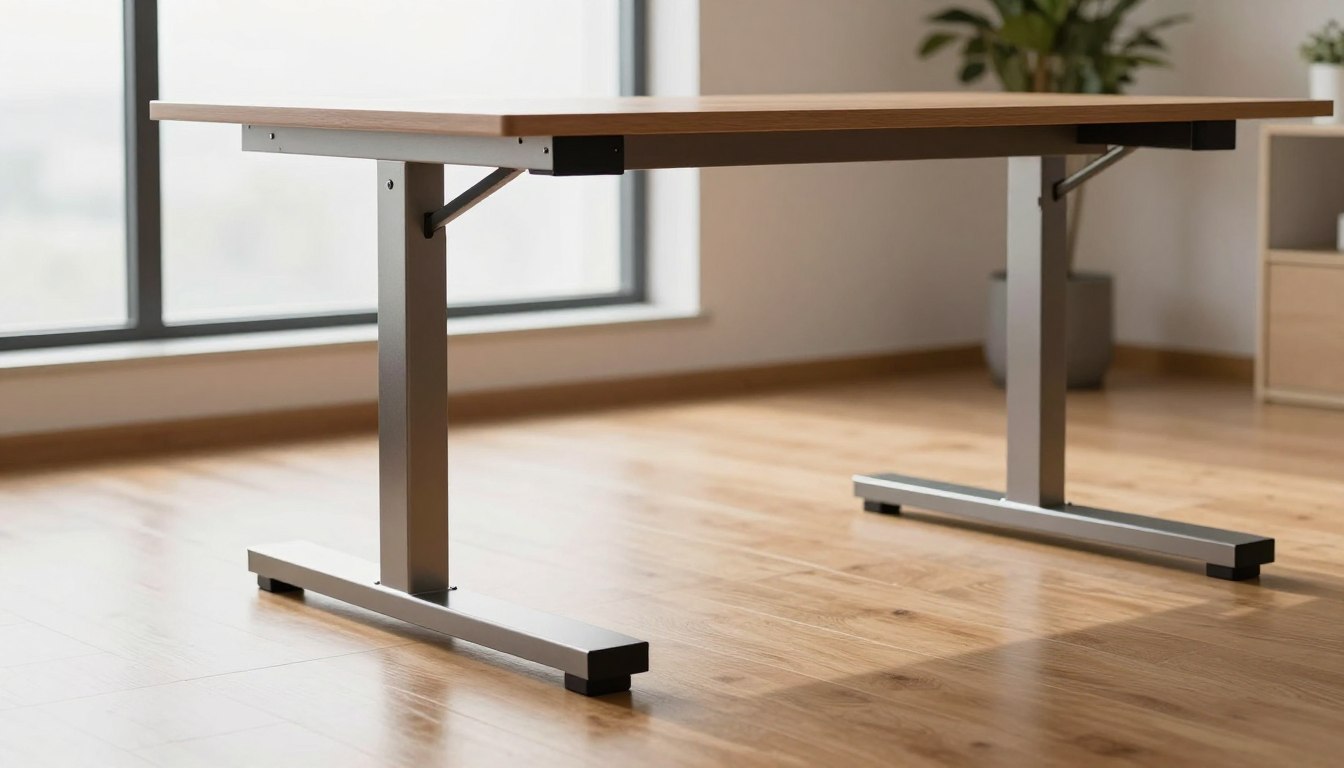
A sturdy adjustable desk base, constructed from high-quality steel and aluminum, showcasing a modern design with an industrial finish. The foreground features the desk frame with visible reinforced joints, sturdy crossbeams, and a sleek height adjustment mechanism, highlighting its heavy-duty build. In the middle ground, the desk stands on a polished wooden floor, illuminated by soft, natural light from a large window, creating an inviting workspace atmosphere. The background includes subtle hints of an office environment with blurred, minimalist decor and plants to enhance the calming mood. The angle captures the desk at eye level, emphasizing the robust construction and stability, evoking a sense of reliability and professionalism.
Surface Treatments and Long-Term Durability
Surface treatments help a standing desk frame last longer by protecting it from corrosion and wear. Common treatments include powder coating, electroplating, and anodizing.
For more on desk quality, stability, and safety, check out our guide on desk quality, stability, and safety.
Motor Systems and Lifting Mechanisms
The efficiency and reliability of a heavy-duty standing desk depend on its motor system and lifting mechanism. For electric standing desks, the motor system is key. It determines the desk's ability to handle heavy loads and adjust height smoothly.
When picking a heavy-duty electric desk frame, knowing the difference between single and dual motor systems is crucial. Dual motor systems are better for heavy-duty use because they have more power and stability.
Single Motor vs. Dual Motor Systems for Heavy Loads
Single motor systems work well for lighter loads and smaller desks. But for heavy-duty needs, dual motor systems are a better choice. They offer:
- Increased weight capacity
- Improved stability and reduced wobble
- Smoother and quieter operation
Dual motor systems spread the workload evenly. This reduces strain on each motor and boosts performance.
Lifting Speed Specifications and Duty Cycle Ratings
Lifting speed and duty cycle ratings are key to a heavy-duty electric desk frame's performance. Lifting speed is how fast the desk moves from its lowest to its highest position.
A higher duty cycle rating means the motor can handle more frequent height changes without overheating or failing. For heavy-duty use, look for motors with high duty cycle ratings for reliability.
Control Panels and Programmable Height Memory
Modern heavy-duty electric desk frames have advanced control panels with programmable height memory. This lets users save their favorite heights for easy switching between sitting and standing.
Wired vs. Wireless Control Options
Control options significantly impact user convenience. Wired controls are dependable and straightforward, whereas wireless controls provide greater flexibility and a tidier workspace.
When choosing between wired and wireless controls, consider your specific requirements and preferences. Both options have advantages, and the optimal choice will depend on your workflow and workspace arrangement.
Frame Configurations and Size Options
Heavy-duty standing desk frames are available in a variety of shapes and sizes. They accommodate different desktop dimensions and cater to diverse user needs, ensuring a suitable fit for every workspace.
Two-Leg Standard Frames for Most Applications
Two-leg standard frames are the most popular for heavy-duty standing desks. They are stable and affordable, fitting well in most offices. These frames support desktops from 30 to 60 inches and can handle heavy weights.
Key benefits of two-leg frames include:
- Ease of installation
- Adjustable width to fit various desktop sizes
- Robust construction for heavy loads
Three-Leg and Four-Leg Frames for Extra Large Desktops
Three-leg and four-leg frames are best for big desktops or commercial spaces. They offer extra stability and support. These frames are perfect for heavy-duty use, like large workstations or team areas.
Advantages of three-leg and four-leg frames:
- Enhanced stability for large desktops
- Increased weight capacity
- Suitable for high-traffic or commercial areas
A detailed depiction of various heavy-duty standing desk frame configurations in a modern office setting. In the foreground, display a selection of robust desk frames in different heights and widths, showcasing their sturdy construction and adjustable features. In the middle ground, include close-up views of the mechanics, highlighting strong joints and powerful lifting mechanisms. The background should feature a bright, organized office environment with ergonomic chairs and large windows, filling the scene with natural light. The mood should be professional and innovative, emphasizing functionality and design. Use soft, diffused lighting to create an inviting atmosphere, and apply a slight tilt shift effect to emphasize the desk frames in the foreground.
Width Adjustment Ranges and Desktop Compatibility
Choosing a heavy-duty standing desk frame means looking at the width adjustment range. This ensures it fits your desktop. Most frames adjust to different sizes.
Frame Type | Width Adjustment Range | Desktop Size Compatibility |
Two-Leg Standard | 30-60 inches | Standard office desktops |
Three-Leg | 48-72 inches | Large desktops and workstations |
Four-Leg | 60-96 inches | Extra-large desktops and commercial applications |
Height Range Specifications for Different User Heights
Heavy-duty standing desk frames also adjust in height to fit different users. It's important to pick a frame that adjusts to both standing and sitting heights.
Typical height adjustment ranges:
- Standard: 24-48 inches
- Extended: 18-50 inches
By thinking about these details, you can find a heavy-duty standing desk frame that suits your needs. It will make your workspace comfortable.
Conclusion
Choosing the right heavy-duty standing desk frame is key. You need to look at load capacity, stability, build quality, and motor systems. This helps you pick the best one for your needs, whether at home or for a commercial space.
A commercial grade standing desk frame is built for heavy use. It offers a stable and durable workspace. With this guide, you'll find the perfect frame for your needs. This ensures a productive and comfortable work environment.
FAQ
What exactly qualifies a product as a standing desk frame heavy duty model?
A heavy duty standing desk frame has a high weight capacity, usually over 300 pounds. It's made of thick steel and meets commercial grade standards. Brands like Uplift Desk and Fully use top-quality materials that last long.
Why is the difference between static and dynamic load important for a sturdy adjustable desk base?
The static load is the desk's max weight when still. The dynamic load is how much it can move safely. A high dynamic rating is key to avoid motor burnout from heavy items.
How do we ensure a stable stand up desk base doesn't wobble at its highest setting?
Stability at full height is crucial. Look for multi-stage legs and heavy-duty feet. Brands like Steelcase and Herman Miller focus on these features for a solid base.
What are the benefits of a dual-motor system in an ergonomic sit-stand desk frame?
A dual-motor system offers better performance than single-motors. It provides smooth, fast, and synchronized lifting. This is vital for moving heavy weights smoothly.
Is a four-leg frame better than a two-leg durable standing workstation frame?
For large or heavy desks, a four-leg frame is better. It prevents wobble and offers a stable experience. The FlexiSpot E7 Plus is a great example.
What materials should we look for in a robust height adjustable desk frame?
Look for frames made from high-grade, powder-coated steel. A thickness of 12 to 14 gauge is recommended. Also, check for reinforced welded joints for added strength.
Can we use a commercial grade standing desk frame for home office setups?
Yes, we highly recommend it. Commercial grade frames are built for heavy use and last longer. Brands like Vari ensure your desk lasts for years.
Add:1F,NO.3 Factory building,green home industry park.ANJI County,ZHEJIANG Province.
About Us
About Us
Product
Product