Office Phone Booth Dimensions: Space Planning, Door Swing and Power Needs
Created on 03.16
Finding a quiet spot in a busy office can be tough. Privacy pods offer a solution for private chats and focus without taking up much space.
When planning your layout, it's important to check specific equipment sizes for a perfect fit. Comfort should always be the top priority in a professional setting. Small changes in placement can greatly improve utility.
Adding a quiet nook can change a chaotic area into a peaceful space. Our goal is to guide you through your next project.
office phone booth dimensions
Scale is just the start; we must also think about entrance placement and laptop power. Proper planning ensures better air flow and ease during long calls. Let's explore how to set up these units for smoother and more pleasant daily tasks.
Getting the details right leads to a better environment for everyone. We're here to help you meet the technical needs of your modern facility. This ensures every team member has the space they need to thrive.
Key Takeaways
- Correct pod sizing ensures a comfortable user experience.
- Door swing radius is critical for narrow hallways.
- Integrated electric outlets support long calls and laptop use.
- Ventilation matters for small enclosures to maintain air quality.
- Placement affects the natural flow of workplace traffic.
- Soundproofing quality varies by model and installation setup.
Standard Office Phone Booth Dimensions Explained
Office phone booth sizes vary, and picking the right one is key for comfort and function. We'll look at the different sizes and their details to guide your choice.
Compact Telephone Booth Dimensions for Single Users
Compact booths are for one person and great for small spaces or offices.
Width and Depth Measurements
These booths are about 4 feet wide and 4 feet deep. They fit well in small areas. The compact size is perfect for small offices or as a quiet spot in bigger ones.
Interior Space for Comfort
Even though they're small, these booths are designed for comfort. The inside space is made to let someone stand or sit comfortably.
Medium and Large Office Phone Booth Sizes
For spaces that need room for more than one, medium and large booths are available.
Two-Person Booth Specifications
Medium booths fit two people and are about 6 feet wide and 4 to 6 feet deep. They're ideal for team discussions or small meetings.
Conference-Style Phone Room Dimensions
Large booths are for groups and are perfect for team meetings or calls. They can be up to 8 feet by 8 feet or bigger, depending on needs.
Height Requirements and Ceiling Clearance
The booth's height is also important. Most are 7 to 8 feet tall. But, make sure the ceiling is high enough for the booth to fit well.
Booth Type | Width (feet) | Depth (feet) | Height (feet) |
Compact | 4 | 4 | 7-8 |
Medium | 6 | 4-6 | 7-8 |
Large/Conference | 8+ | 8+ | 7-8 |
For more info on choosing the right office phone booth, check out this resource. It has details on the different options.
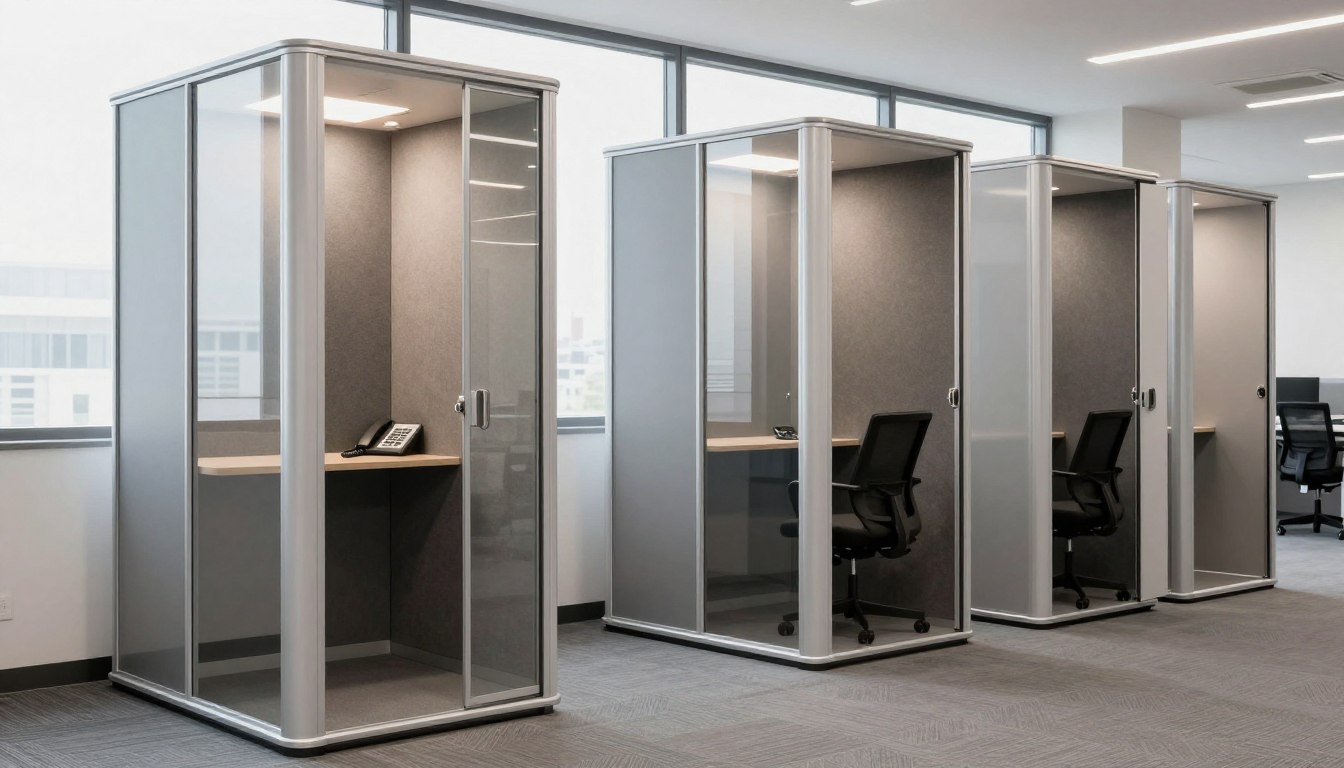
A modern office environment showcasing various sizes of phone booths, designed for professional use. In the foreground, a standard-sized phone booth with clear glass walls, featuring a sleek acoustic interior and a small desk with a phone, sits prominently. Adjacent to it, a larger booth demonstrates extra space for two people, with ergonomic seating and soundproofing panels. Behind these, several dimensions of phone booths are displayed, emphasizing their varying heights, widths, and door configurations, complete with open doors showing their interiors. The lighting is bright but soft, mimicking natural daylight from nearby office windows. The angle captures the booths in a dynamic perspective that highlights their functionality and design, creating a professional yet inviting atmosphere suitable for a workspace.
Space Planning Essentials for Your Office Phone Booth
When figuring out the space needed, we must think about the booth's size and the space around it. The standard office booth dimensions can change, but picking the right ideal phone booth dimensions is key for your office's layout.
Calculating Total Floor Space Needed
The booth's footprint is the area it takes up. But, we also need space around it for comfort and easy access.
Booth Footprint Plus Clearance Zones
At least 3 feet of space around the booth is needed for movement. This space is part of the phone booth specifications to consider when planning.
Multiple Booth Spacing Guidelines
For multiple booths, following specific spacing rules is important. Keep at least 6 feet between booths to avoid overcrowding and ensure privacy.
Booth Configuration | Minimum Clearance | Recommended Distance Between Booths |
Single Booth | 3 feet around the booth | N/A |
Multiple Booths | 3 feet around each booth | 6 feet |
Strategic Placement in Open Office Environments
Placement should balance between busy areas and quiet spots. Consider the booth's distance to workstations and meeting rooms. Placing booths in high-traffic areas is convenient but might be distracting.
High-Traffic Areas vs. Quiet Zones
Quiet zones, on the other hand, provide a calm environment, which can boost productivity. It's about finding the right spot based on your office's needs and layout.
Distance from Workstations and Meeting Rooms
It's also key to think about the booth's distance to workstations or meeting rooms. They should be close but not too close to avoid distractions.
Accessibility and Traffic Flow Considerations
To do this, we must think about the office's traffic pattern. Place booths so they don't block the way. Making sure office phone booths are easy to get to and don't slow down traffic is vital for smooth operations.
Door Swing Requirements and Clearance Specifications
The door swing of an office phone booth is key to its space needs and user experience. We must look at different door swings and their clearance to make sure the booth is easy to use and accessible.
Outward-Swinging Door Dimensions
Outward-swinging doors are popular for office phone booths. They make it easy to get in and out without taking up too much space inside the booth.
Minimum Clearance Zone Measurements
For outward-swinging doors, enough space outside the booth is crucial. The clearance zone should be big enough to avoid blocking hallways or other areas. A minimum clearance of 12 inches is often recommended beyond the door's swing arc.
Impact on Hallway and Aisle Width
The door's swing can affect hallway and aisle widths. We need to make sure the door doesn't block the path or create a narrow spot. For example, in tight corridors, an outward-swinging door might not be the best choice.
Inward-Swinging and Sliding Door Options
Inward-swinging and sliding doors are good alternatives for office phone booths. Each has its own benefits.
Space-Saving Sliding Door Specifications
Sliding doors save space because they don't need clearance for swinging. They slide along a track, perfect for small areas. When choosing sliding doors, make sure the track is smooth and quiet.
Bi-Fold Door Clearance Needs
Bi-fold doors fold inward or outward when opened. They save space but need careful clearance to avoid blocking areas when folded.
ADA Compliance and Universal Design Standards
It's important for office phone booths to meet ADA standards for accessibility.
Wheelchair Turning Radius Requirements
The ADA states that the booth's interior must accommodate a wheelchair turning radius of at least 60 inches (1524 mm). This ensures ease of movement for wheelchair users.
Door Handle and Opening Force Specifications
Door handles should be easy for individuals with disabilities to operate. The ADA specifies that handles should not require tight grasping or twisting. The door should open with a force of no more than 5 pounds.
A detailed rendering of an office phone booth, showcasing its dimensions and door swing requirements. In the foreground, the booth is positioned at an angle to highlight the entrance, with a clear view of the interior space. The middle ground features accurate measurements marked on the booth's walls, illustrating the necessary clearance specifications for the door swing. The background includes a modern office setting with desks and soft, ambient lighting. The scene should evoke a professional atmosphere, emphasizing functionality and space planning. Use a wide-angle lens to capture the entire structure, ensuring the lighting is bright and even, enhancing the clarity of the dimensions illustrated within.
Power Needs and Electrical Infrastructure Planning
When designing an office phone booth, it's crucial to consider the power needs. This ensures it remains functional and comfortable for users. A well-designed electrical infrastructure supports the various devices and systems within the booth, enhancing user experience.
Electrical Outlet Requirements and Placement
Proper placement of electrical outlets is vital for convenience and safety. Outlets should be positioned to minimize cord clutter and ensure easy access.
Standard 110V Power Outlet Specifications
Standard 110V outlets are typically required for office phone booths. They power devices such as phones, laptops, and other equipment. It's essential to specify the correct type and number of outlets based on the booth's intended use.
Optimal Outlet Height and Location
The height and location of outlets should be planned to reduce tripping hazards and ensure accessibility. Typically, outlets are placed near the floor or at a comfortable height for users.
USB Charging Ports and Device Power Options
With the increasing reliance on personal devices, incorporating USB charging ports within the phone booth is becoming a necessity. This includes considering the type and number of USB ports required.
Integrated USB-A and USB-C Port Capacity
Both USB-A and USB-C ports should be considered to accommodate different device types. The capacity of these ports should be sufficient to charge multiple devices simultaneously.
Wireless Charging Pad Power Draw
Wireless charging pads offer a convenient way to charge devices without the clutter of cables. Their power draw should be factored into the overall power requirements of the booth.
Ventilation System and Lighting Power Consumption
The power consumption of the ventilation system and lighting within the booth is crucial. It helps maintain a comfortable environment while keeping energy costs in check.
HVAC Fan Wattage Requirements
The wattage requirements for HVAC fans depend on the size of the booth and the desired airflow. Proper sizing ensures efficient operation and adequate ventilation.
LED Lighting Power Specifications
LED lighting is energy-efficient and provides excellent illumination. Understanding the power specifications for LED lighting helps in designing a booth that is both well-lit and energy-efficient.
To summarize the key considerations for power needs and electrical infrastructure planning:
- Assess the total power requirements for all devices and systems.
- Plan the placement of electrical outlets and USB ports for convenience and safety.
- Consider the power consumption of ventilation systems and lighting.
- Ensure that the electrical infrastructure is scalable for future needs.
Conclusion
Creating an effective office phone booth requires careful thought. You need to consider its size, space planning, door swing, and power needs. Knowing the standard sizes is key to making a space that works well for everyone.
Choosing the right size and planning the space well is important. This ensures your office phone booth meets your team's needs. For example, the Quelldesign office phone booth is soundproof and private. It has dimensions that fit well in most offices, with a footprint of about 1.1 m (W) x 0.9 m (D) = 0.99 m² and weighs 224 kg.
We've shared important tips for setting up office phone booths. By using these tips, you can make a space that's both productive and comfortable. This will help support your employees' needs.
## FAQ
### Q: What are the standard office booth dimensions for a typical workspace?
A: The size of an office booth depends on its use. For one person, booths start at about 40" x 40". Brands like Framery and ROOM make these booths compact but comfy. For two people or small meetings, booths can be up to 80 inches wide.
### Q: How much space should we allocate for door swing and clearance?
A: Planning space for booths is more than just their size. We need room for doors to swing out, needing 36 to 42 inches. For tight spaces, consider sliding or bi-fold doors from Poppin or Hushoffice to keep traffic flowing.
### Q: What are the best phone booth measurements for ADA compliance?
A: For accessibility, booths should be 60" x 60" to fit a wheelchair. We also check door handles and opening forces to make sure everyone can use the booth easily.
### Q: What kind of power needs and electrical infrastructure should we prepare?
A: Most booths are easy to set up with a 110V outlet. They often have USB ports and sometimes wireless charging. We also think about the fan and lighting power to keep the booth efficient and comfy.
### Q: How do we determine the right height requirements and ceiling clearance?
A: Booths are usually about 90 inches tall. Make sure your ceiling is at least 6 to 12 inches higher. This space is key for the booth's ventilation and for the install team.
### Q: Where is the most effective place to position a booth in an open office?
A: Place booths where they're easy to get to but not too loud. Near busy areas but not too close to desks. This way, booths can be in quiet spots or near meeting rooms without disturbing others.
Add:1F,NO.3 Factory building,green home industry park.ANJI County,ZHEJIANG Province.
About Us
About Us
Product
Product